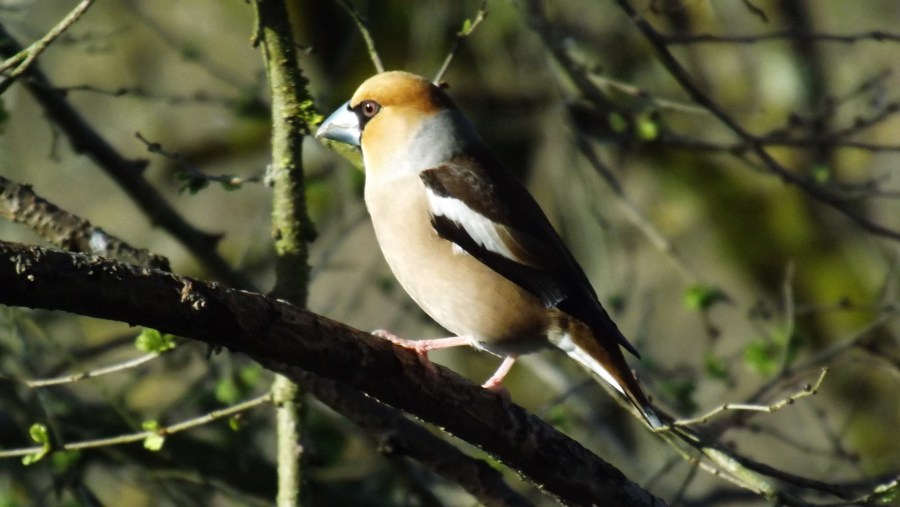
Philippe is impressed. Behind the double-glazed French window, comfortably seated in an armchair, we can watch them all day without disturbing them, and it’s such a treat.
It’s true, there are so many birds around the feeder at any given time, and this year seems to be the year of the nutcrackers. There have never been so many, and they are the first ones here at dawn. We counted six this morning.
I remember the winter of 2018 was the year of the goldfinches. There were at least twenty of them feeding here. Since then, we see one or two from time to time, but never more than that.
Barely two meters from the window, our friends find sunflower seeds galore, seed balls, peanuts, and butter… On the front of the feeder, there’s a watering trough for bathing and feather grooming sessions. We could watch them for hours.
From time to time, one bumps into the window and get a little stunned. Sometimes one falls after the hit and doesn’t get up again too violent the impact. Fortunately, this is rare, and several times we’ve been able to pick it up, and by keeping them warm and safe in our palms, they’re wriggling again after a few minutes. Such incredible resilience!
One year we had a dove hitting the glass, fighting its own reflection for hours, unable to comprehend the trick, poor thing. Luckily it didn’t seem to do itself any damage.
Rare also but real is the sparrow hawk, hunting. In winter, it’s easier as it can navigate between the branches of the bare elm and doesn’t often miss its prey. Its passage is spectacular: It flies so quickly past the window that we barely have time to know what has just happened. The clues are clear though: With the blink of an eye all the birds have disappeared and silence is so loud… they’ve all gone hiding in the bushes below.
Thankfully summer is a safer time for them all; The elm, like a mother hen, offers them the necessary protection, and they are less vulnerable.
One year, sitting on the terrace, Cousin Jean-Cri listed all the birds he could see or hear around us and in the small wood under the balcony. He counted 23: blue tits and, great tits, greenfinches, accentors, blackbirds and magpies, sparrows, nuthatches, chaffinches, woodpeckers, jays of course, and pigeons, a robin, a wren, marsh tits, our nightingale, our cuckoo, the crows, the pair of hoopoes, an oriole… and those I’ve forgotten. Responsible for wildlife and flora in the area north from us, he spent his entire days in the great outdoors and his ear was very keen.
Geoff now recognizes quite a few of their songs, which remain a mystery to me, and he observes their antics around the bird feeders: the tits are tolerant. They toss the few seeds that don’t suit them before choosing one and going to open it in the elm above. The finches feed on the balcony with the discarded seeds, the sparrows have learned to cling to the seed balls, which is new.
The nutcrackers sit directly on the feeder, and there’s no room for anyone else. When these are done eating and deign to fly away, the other small passerines waiting their turn rush to help themselves. The greenfinches are the most aggressive. The robin doesn’t like competition, but given its size, it doesn’t have much of a choice. The woodpeckers don’t stop all day: one by one, they come to collect seeds, which they hide in a tree trunk, making reserves for later.
A pair of shy turtledoves nesting in the cypress comes from time to time to observe and drink only as they don’t have access to the seeds. The pigeons’ nest in the chestnut tree was destroyed by a strong wind, and they haven’t returned this year. I saw them carrying twigs, but I don’t know where their new nest is. Perhaps in the ivy covering the dead ash tree a little further down… we hear things from that direction… and we wonder when that ash tree will finally fall… The flamboyant jays seem enormous to us when they come to help themselves to the butter. We had to wrap the dish in fine wire mesh so they can’t carry off half its contents in one go.
The hoopoes, magpies, and blackbirds feed in front of the kitchen window where the grass is short and predators visible. We’ve never seen the nightingale, the wren, the golden oriole, or even the cuckoo, which is very silent this year. Camille, at 93, knows a lot of things: yesterday she told me that we are a moon behind and the current moon is a cold moon. Since the moon change is today, warmth is coming our way. The cuckoo, she tells me, will come out then.
 La dame aux ânes